Automating Gathering and Smyth Sewing for Hardcover Books: Bottlenecks and the ARS Solution
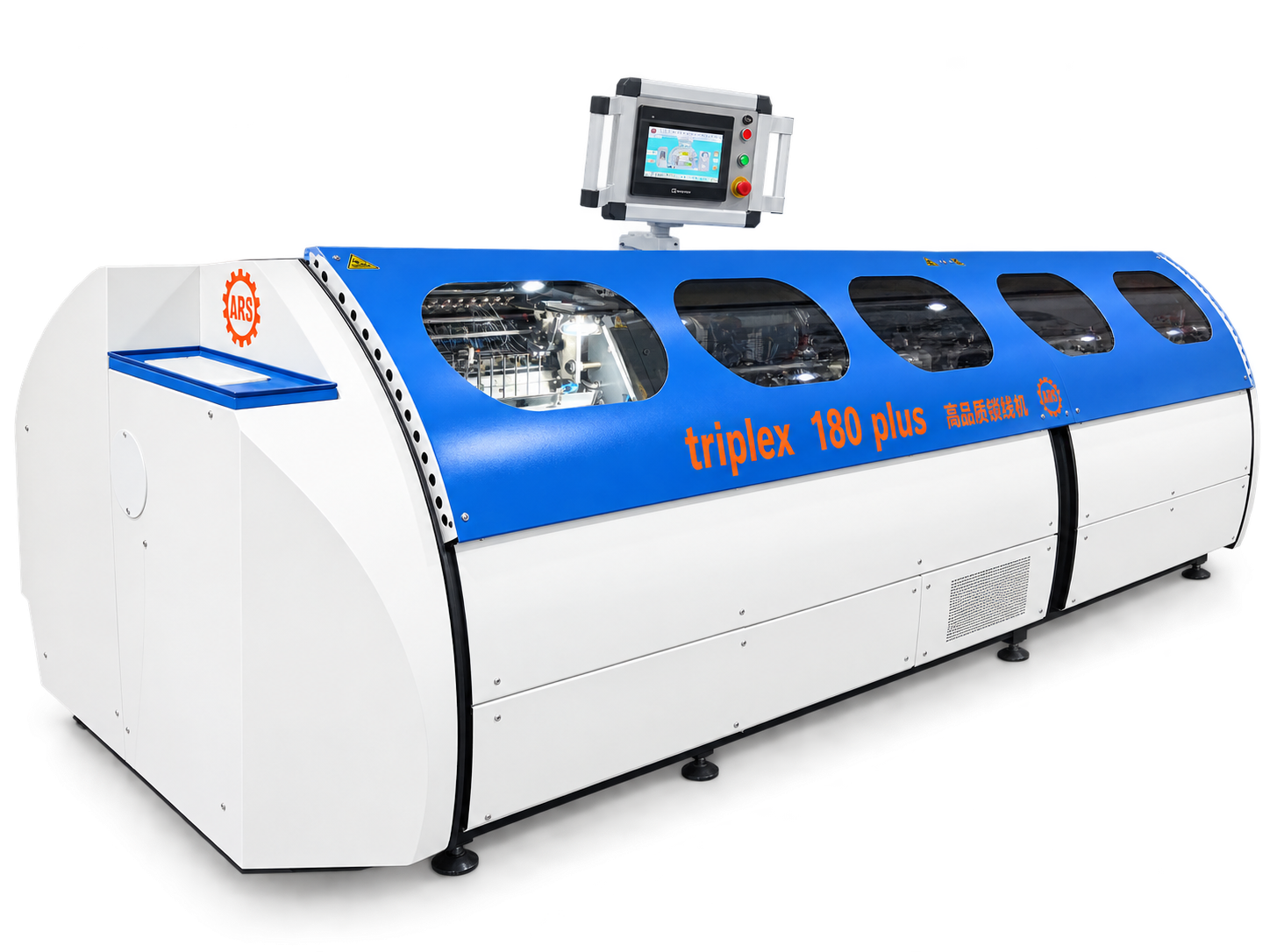
From the bindery floor, the hardest part of hardcover production is rarely the casing-in machine. It is the upstream combination of gathering and thread sewing. Signatures must arrive in the correct sequence, open cleanly on the saddle, and be stitched with stable tension—every time, at speed. When any one of these fails, the whole case-binding line loses output and quality.
1. Process difficulty in gathering
Gathering looks simple: pull folded sections from stations and assemble them in order. In practice it is where most hardcover defects start.
Wrong-sequence and missing sections. Multilingual Bibles, reference books, and color-plate albums often use dozens of signatures. Manual checks or periodic sampling cannot guarantee every book block. Camera-based sequence control—reading barcodes, text, or images—is now the standard safeguard in automated lines.
Double or incomplete pickup. Thin Bible paper, coated art stock, and unevenly folded sections behave differently in the same hopper. A feeder tuned for 90 gsm text may double-feed 28–40 gsm onion-skin or scratch coated stock.
Opening and registration. A section that is not fully opened at the fold will be mis-sewn; stitches land off-center, holes enlarge, and glue can later seep into inner pages during casing-in. Lightweight signatures especially need programmed acceleration and saddle registration rather than fixed mechanical timing.
2. Process difficulty in Smyth sewing
Even with perfect gathering, sewing introduces its own constraints.
Tension control. Too tight and the spine swells, causing problems at rounding, backing, and casing-in; too loose and the block lacks stability. This is most critical on thin Bible paper and on mixed blocks where body text, inserts, and endpapers have different caliper.
Needle and hole quality. Ultra-short needles and controlled penetration reduce fiber tear. On thin stock, blunt or oversized needles cause broken/short signatures and higher reject rates.
Stitch pattern and thread buildup. Standard, staggered, or continuous-staggered patterns change spine thickness and pull-test results. Hardcover plants must match stitch style to final book thickness, round-back requirements, and casing-in tolerances.
Changeover discipline. Inputting size, signature count, stitch pitch, and tension by hand invites error. Recipe-driven setup shortens changeover and reduces dependence on one expert operator.
3. Capacity reality, not nameplate speed
Vendors quote peak signatures per minute. Real hardcover capacity should be modeled as:
effective output = gathering reliability × sewing uptime − changeover time − rejection reprocessing
A 200 spm sewing head means little if the gatherer double-feeds every ten minutes, the operator stops to check sequence, or thin sections jam at the saddle. Automated gathering-and-sewing lines reduce intermediate storage and transport, and can be run with very few operators when feeding, inspection, and sewing are integrated. The productivity gain comes less from higher peak speed and more from fewer stops.
4. The ARS approach: multi-feeder sewing with graphic inspection
For hardcover modernization, ARS positions the sewing node as a closed-loop workstation rather than a standalone machine.
Multi-feeder automatic sewing. The new ARS multi-feeder configuration can be deployed as an integrated gathering-to-sewing line, as automatic set-in/set-over feeding for pre-gathered stacks, or as a single-machine sewing node for existing plants. This gives binderies a staged upgrade path: start with one automatic sewer, then add feeders as volume and format mix grow.
Graphic detection system. Each reference book or approved signature set is scanned once; the system then compares every incoming section by image fingerprint, barcode, or printed mark. Missing, duplicated, inverted, or out-of-sequence signatures are identified before stitching, so a wrong section is never locked into the book block. For multilingual Bibles and premium notebooks, this replaces subjective visual checking with recorded, auditable inspection.
Auto-make-ready and recipe storage. Book size, signature count, stitch pattern, feed timing, and tension parameters are saved per job. Repeat hardcover formats are recalled in seconds; mixed-thickness jobs are handled through adaptive feed settings rather than manual resetting between lots.
Thin-paper readiness. For 28 gsm and similar Bible stocks, ARS combines gentle separation, controlled saddle opening, and stable low tension. The objective is continuous running without the "expert operator only" condition that dominates many European Bible plants.
Line integration. Outfeed book blocks are handed to nipping/back-gluing or casing-in with production data—counts, alarms, rejection reasons, and job ID—available for MES reporting. This supports traceability expectations under modern EU machinery compliance thinking, including digital records and remote diagnostics.
5. Implementation logic for hardcover plants
For short-run premium books: use ARS single-machine mode with graphic detection and stored recipes; changeover time, not sewing speed, becomes the main KPI.
For medium-run hardcover and notebooks: use multi-feeder automatic gathering plus ARS sewing; let the vision system enforce sequence control and let buffers absorb gatherer/sewer tempo differences.
For high-run Bibles: integrate multi-feeder ARS with upstream folding and downstream nipping/casing-in; validate 28 gsm performance on your actual paper, set tension and stitch pattern by book thickness, and track rejects by signature rather than by whole shift.
Bottom line
Hardcover automation succeeds when gathering and sewing are treated as one quality system. The ARS solution—multi-feeder automatic sewing, graphic fingerprint inspection, recipe-driven make-ready, and flexible single/inline deployment—addresses the two issues that actually limit hardcover throughput: wrong-section risk and thin-paper instability. Done properly, plants move from "skilled operators rescuing the line" to scheduled, auditable, high-yield Smyth sewing.
Tags
Share This Article
Need Help Choosing Equipment?
Our technical experts can provide personalized recommendations based on your specific production requirements and budget.
Contact Our Team